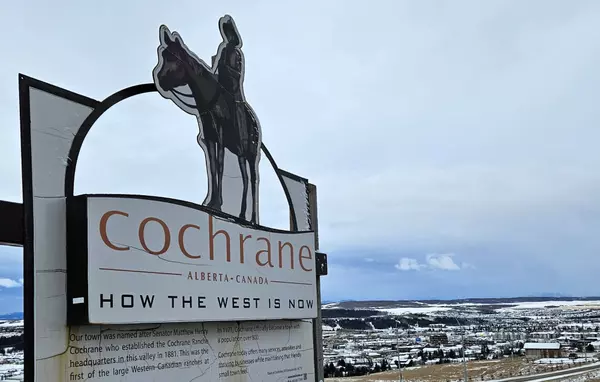
Cochrane Capital Plans 2026–2027: How Infrastructure Will Impact Commercial Real Estate
Updated September 2026
If you own, lease, or are shopping for commercial property in Cochrane, Alberta, the next 24 months matter more than a decade of headlines. The Town is finishing a generation-defining highway interchange, pushing a new north–south arterial through the south side, expanding water capacity, and implementing Envision Cochrane 2050 — the municipal development plan adopted on March 10, 2025.
Those plans change who can get a truck onto a site, which parcels can actually be serviced, where retail rooftops will cluster, and how quickly Council will support non-residential development. Cochrane’s unofficial population is now estimated at about 39,385 after roughly 6.4% growth in 2025. Residential demand is still strong. The policy shift underway is to grow the commercial and industrial tax base faster than the housing base.
This guide walks through the live capital program, the statutory plans behind it, and the commercial real estate implications by submarket.
Why Cochrane’s capital program matters to commercial property
Commercial real estate in a fast-growing satellite of Calgary is priced on access, servicing, labour, and municipal intent — not architecture alone. Cochrane sits at Highway 1A and Highway 22, about 20–25 minutes from northwest Calgary, with a Bow River valley setting that has already pulled in employers such as Garmin Canada’s Canadian headquarters.
Three facts frame the next cycle:
- Growth is still hot. The 2025 municipal census counted 37,011 residents. Permit-based estimates put year-end 2025 population near 39,385, with 913 new homes completed and 2,547 business licences issued.
- Employment land is finite. The Town reports about 39.28 hectares of approved, vacant, developable commercial and industrial land across nine neighbourhoods. Southbow Landing alone accounts for more than half of that.
- Council wants an 80/20 residential-to-non-residential mix over the long term, as set out in Envision Cochrane 2050. Only about 23% of 2025 development permits were non-residential. That gap is now a fiscal priority, not a footnote.
Alberta’s regional dashboard put the value of major Cochrane projects at about $189.3 million in 2025. That kind of public-works pipeline usually precedes a lift in highway retail, light industrial, and neighbourhood commercial values — after construction disruption fades.
The live capital projects that will move commercial values
Town capital work is guided by Council priorities, the 10-year financial strategy, and the strategic plan. These are the files commercial buyers should underwrite.
1. Highway 1A / Highway 22 interchange (spring 2023 – summer 2026)
This is the single most important transportation project in Cochrane in a generation. The old at-grade intersection was already handling more than 29,000 vehicles a day. The new interchange grade-separates the two highways, adds ramps, widens the Highway 1A approach, and improves truck movement toward Highway 1 and the Highway 22 corridor.
By late December 2025, traffic was operating on permanent roads and ramps, including a dual left-turn from Sunset Boulevard onto southbound Highway 22 and a new pedestrian link toward the Cochrane Ranche. Final paving, landscaping, and remaining lighting run through 2026.
Commercial impact: Interchanges create nodes. Sites with visibility from the new ramps, Sunset Boulevard, and the Highway 22 approaches become more valuable for fuel, QSR, automotive, grocery-anchored retail, and light industrial that needs highway access. Construction risk is largely behind the market. What remains is a finishing season, then several years of more reliable travel time.
2. James Walker Trail Stage 3 (summer 2025 – 2027)
James Walker Trail is the missing arterial that ties north and south Cochrane and takes pressure off River Heights Drive. Stage 3 is about 2.5 km: roughly 1.5 km built by the Town and 1 km inside Southbow Landing built by Qualico. Stages 1 and 2 already rebuilt Griffin Road connections and tied into the Jack Tennant Memorial Bridge. Stage 4 would widen the road to four lanes when traffic warrants it.
Commercial impact: This road is the skeleton of south-side commercial. Southbow Landing is planned for about 2,900 homes and the largest commercial and employment area on the south side of the river. Until the arterial is in, those pads are harder to lease. Once Stage 3 is open, neighbourhood retail, medical, services, and employment-industrial get a real address.
3. River Heights pump station and water storage expansion (spring 2025 – summer 2026)
Water and wastewater — not zoning maps — are the real gate on commercial intensification. The River Heights pump station and reservoir expansion supports south-side growth.
Commercial impact: Servicing capacity decides when a 10-acre employment parcel is actually shovel-ready. Get written confirmation of water allocation, fire-flow, and sanitary capacity before you treat a listing as developable.
4. Glenpatrick Drive infrastructure replacement (spring 2025 – fall 2026)
A full rebuild of aging water, sewer, storm, and road infrastructure in Glenbow, plus new sidewalks, pathways, and a traffic circle near Glenbow School.
Commercial impact: Reliable underground infrastructure reduces the risk of a utility failure that shuts a tenant down. Short-term, expect construction friction through 2026.
5. Centre Avenue (Phases 3 and 4 substantially complete)
Centre Avenue is the spine between historic downtown, The Quarry / Griffin Road commercial district, and growing central neighbourhoods.
Commercial impact: Better circulation is already priced into The Quarry and Griffin Road. Remaining upside is downtown-to-Quarry connectivity for restaurant, boutique, and service retail.
6. Horse Creek Sports Park — master plan, design, and servicing
North of Heritage Hills, this quarter-section recreation campus is moving through design and servicing, including preparation of Rocky View Schools land for a future school.
Commercial impact: Sports parks create destination traffic and support family-serving retail near Heritage Hills employment land (about 3.78 hectares of approved vacant non-residential supply).
The plans behind the projects
Capital budgets are the chequebook. Statutory plans are the rulebook.
Envision Cochrane 2050 (Municipal Development Plan)
Council adopted Envision Cochrane 2050 on March 10, 2025, replacing the 2008 MDP. Its economic pillar is explicit: grow employment lands and work toward a healthier non-residential assessment split. Greystone is already the proof of concept — roughly a third of that community is reserved for offices and retail.
Connecting Cochrane (Transportation Master Plan)
This is the long-range network for vehicles, transit, cycling, and walking. For commercial sites, arterial vs. collector designation often decides whether a drive-through or loading dock is approvable.
Downtown ARP and Integrated Downtown Action Plan
Historic downtown remains Cochrane’s brand. Remaining approved vacant downtown commercial land is only about 2.23 hectares, so value is increasingly in redevelopment, upper-storey office, and adaptive reuse.
Griffin Road, industrial lands, and The Quarry
Griffin Road is still the workhorse employment area. The Quarry pulled big-box retail and Garmin-scale office into the centre of town. Older industrial bays on Griffin should be underwritten for intensification, not just current cap rates.
Rocky View / Cochrane North
Not all “Cochrane area” commercial land is inside town limits. Confirm jurisdiction, servicing, and levies before comparing two listings that both say “Cochrane.”
Where the commercial land actually is
From the Town’s 2025 Development Summary Report (approved vacant non-residential land):
- Southbow Landing — 20.59 hectares
- Greystone — 10.68 hectares
- Heritage Hills — 3.78 hectares
- Downtown — 2.23 hectares
- Other neighbourhoods — the balance of 39.28 hectares total
More than half of the remaining approved vacant employment land sits in Southbow Landing, which is only beginning build-out. If that commercial absorbs quickly, the rest of the map tightens fast.
How these plans change commercial real estate by asset class
Retail and restaurant
Cochrane retail is splitting into four: Highway 1A/22 interchange retail; Quarry / Griffin convenience and big-box; downtown independent retail and food; and Southbow / Greystone neighbourhood retail, which usually lags housing by 12 to 36 months.
Industrial and flex
Griffin Road remains the default for contractors, light manufacturing, indoor recreation, breweries, and innovation uses. Cochrane industrial is still more a local-economy product than Calgary logistics overflow, except on the best highway sites.
Office and innovation
Garmin proved Cochrane can host a headquarters. Expect small professional office, medical, and hybrid industrial-office in Greystone, The Quarry, and downtown upper floors. Non-residential construction value was nearly $14 million in 2025.
Land and development sites
Price in off-site levies, James Walker Trail timing, utility capacity, and whether the site is already districted commercial or industrial. Raw land without a servicing path is a different asset class.
Provincial capital plans: what is funded, and what is not
Alberta Budget 2026 did not earmark a new Cochrane hospital or a named local recreation palace. Nearby items included about $65 million for Highway 1A upgrades along the Stoney Nakoda stretch, $6 million related to Ghost Reservoir flood mitigation, and Cochrane on the long list for a possible Calgary-area passenger-rail corridor. That corridor is studied, not funded. Do not pay a rail premium today.
Short-term pain, long-term premium: 2026–2028
Through late 2026: finishing work on the interchange, Glenpatrick construction, James Walker Trail earthworks, and River Heights utilities.
2027–2028: James Walker Trail Stage 3 should be usable and Southbow commercial gets a real address. That is when national tenants typically re-enter site selection.
After 2028: possible Stage 4 widening, Horse Creek construction, and a tighter employment-land story if residential growth stays elevated. Mayor Morgan Nagel has argued for slowing residential growth toward about 3% while accelerating commercial and industrial growth.
What buyers, sellers, and owner-occupiers should do now
If you are buying: map sites against James Walker Trail, the interchange ramps, and published utilities; get the neighbourhood plan, land-use district, levy estimate, and fire-flow letter before waiving conditions; prefer already-districted commercial or industrial land.
If you already own: revisit rents as the interchange finishes; look at adding a complementary use the Land Use Bylaw already allows; design access for any future four-lane widening.
If you are moving a business from Calgary: Cochrane still offers more building and yard per dollar than inner-city Calgary industrial. Drive the commute at 7:30 a.m. and 4:30 p.m. after the interchange opening, and confirm your use in that specific district.
Risks that do not show up on the glossy capital list
- Southbow commercial can absorb slower than housing
- Off-site levies and build-cost inflation
- No dedicated provincial facility cheque for Cochrane
- Neighbourhood retail slows if housing growth is throttled
- County industrial just outside town can undercut in-town pricing
The bottom line
Cochrane is a 40,000-person foothills town building the roads, water, and planning framework of a small city. The interchange is in finishing mode. James Walker Trail Stage 3 is in the ground. Water storage is being expanded. Envision Cochrane 2050 already points employment land to Southbow Landing and Greystone. Approved vacant non-residential land is only about 39 hectares.
Better access, limited serviced supply, and a Council that wants commercial assessment is the thesis. Underwrite location against the 2026–2028 infrastructure calendar, not last year’s traffic count.
Frequently asked questions
What is the most important Cochrane capital project for commercial property? The Highway 1A/22 interchange is the highest-impact project now finishing. James Walker Trail Stage 3 is the highest-impact growth-enabling project because it unlocks Southbow Landing’s commercial lands.
Is there much commercial land left in Cochrane? Enough for the next cycle, not enough to be careless. Roughly 39 hectares of approved vacant commercial and industrial land remained in the 2025 Town inventory, concentrated in Southbow Landing and Greystone.
Will passenger rail to Calgary help Cochrane commercial real estate? Possibly over a long horizon. Budget 2026 did not fund a line. Do not pay a rail premium today.
How does Envision Cochrane 2050 affect a development permit? Applications that add jobs, complete a mixed-use node, or implement the transportation network generally fit the plan. Applications that consume employment land for housing will face a harder path.
Talk through a Cochrane commercial site
I live and work in Cochrane. If you are evaluating a bay on Griffin Road, a pad in Southbow Landing, a downtown storefront, or a highway parcel near the new interchange, I can pull current listings, planning status, and comparables and help you pressure-test the infrastructure timeline — not just the asking price.
Adam Vetter
REAL Broker AB
413 River Ave, Cochrane, AB T4C 0P2
403-872-4392
adam@adamvetter.com
Categories
Recent Posts